
Kaydan Porter, Owner, Desert Gator Mobile Detailing
November 24th, 2026
5 min read
A car owner in Gilbert notices faint spider-web marks across the driver's door every time the sun hits it at noon. They buy a bottle of polish from an auto parts store, rub it in by hand on a Saturday, and see only a slight shine with the marks still visible underneath. The defects were never in the wax. They were in the clear coat.
The framework for thinking about paint correction
Paint correction is best understood through three dimensions: the defect being removed, the depth of material you can safely take off, and the tools and sequence used to do it. The defect determines the goal. The clear coat's remaining thickness sets the limit. The tools and process determine whether you reach the goal without causing new damage. Every decision in a correction job traces back to one of these three.
Defects and what they require
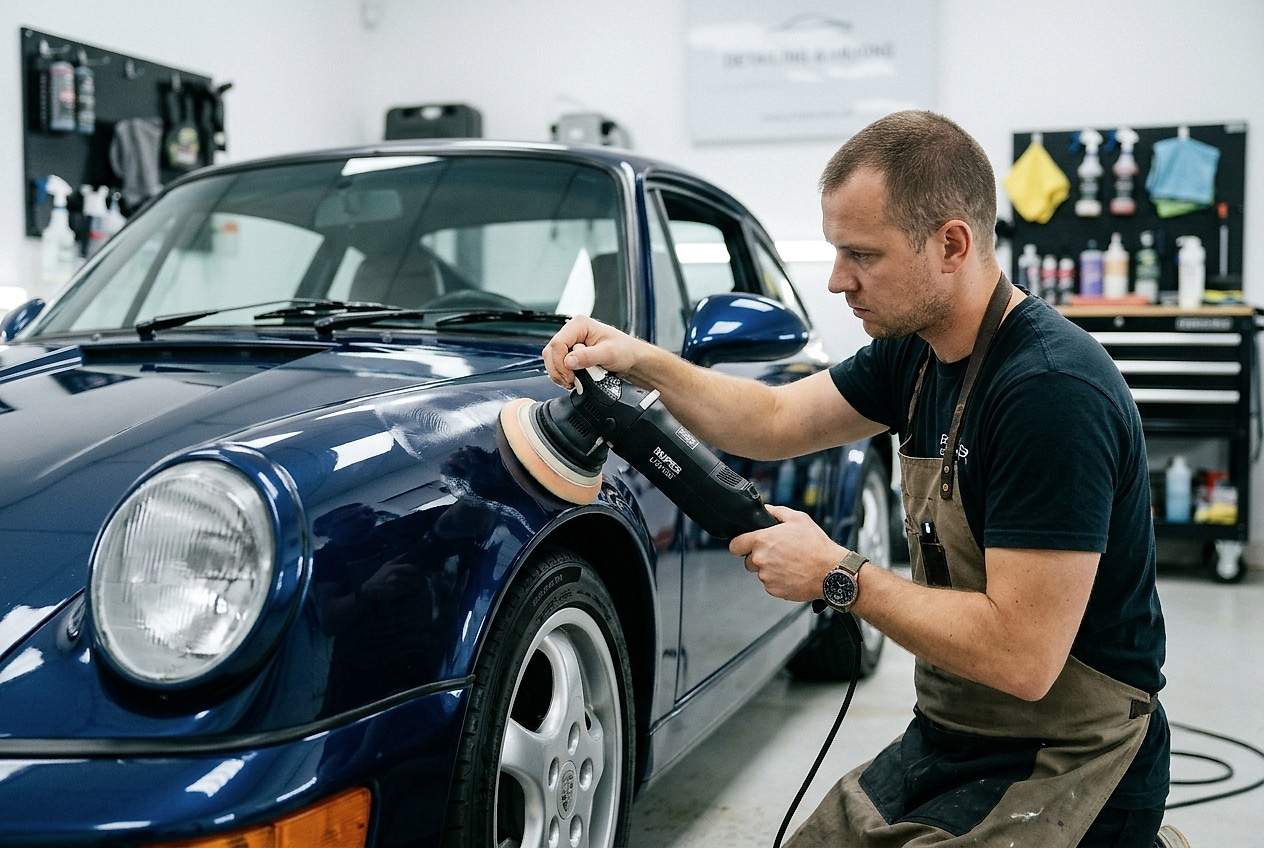
Paint correction is the process of mechanically removing surface defects from a vehicle's paint, which typically include swirl marks, scratches and micro-marring. [5] Most of these defects sit in the clear coat, the transparent top layer that protects the colored base.
Scratch depth decides the approach. A scratch that has gone completely through the clear coat and into the colored paint underneath cannot be fixed by polishing, because the material is already gone. [4] Shallow marks in the clear coat respond well to controlled abrasion.
Stages, compounds, and machines
Correction is performed in stages, each using a more or less aggressive combination of compound, pad, and machine. A single-stage correction uses one cutting step, typically with a compound and a pad, to address light to moderate defects. [2] Multi-stage work adds a cutting step to remove heavier defects, followed by a finishing step that refines the surface and restores gloss.
Compounds contain abrasives that level the clear coat. Polishes contain finer abrasives for refinement. Pads pair with each product: firmer pads cut harder, softer foam pads finish cleaner. The rotary or dual-action (DA) polisher drives the pad, and operator technique controls heat, pressure, and speed. Mismatching any of these components is the most common cause of hazing or holograms in the finish.
Professional methodology versus amateur efforts
The clearest difference between professional and amateur work is measurement and sequencing, not the brand of product. Professionals inspect under controlled lighting, identify defect depth, test a small area, and choose the least aggressive combination that achieves the result. They work panel by panel and check progress between steps.
Amateur efforts usually skip the inspection and start with the most aggressive product on the shelf. That approach removes more clear coat than necessary, shortens the finish's service life, and can leave haze that needs another correction to undo. Hand-applied polish also lacks the consistent speed and pressure a machine provides, so visible defects often remain.
What results to expect
Correction reduces defects. It does not restore a finish to factory perfection in every case. Deep scratches that reach the base coat require touch-up paint or panel refinishing. Heavy oxidation may need multiple passes, and the clear coat's remaining thickness limits how much can be removed safely.
Results are best judged in the light the car lives in. For owners in Mesa, Chandler, Tempe, Apache Junction, and Gilbert, sustained sun exposure makes oxidation and UV-driven fading common, so a correction paired with protection gives longer-lasting gloss. Mobile detailing services, such as desertgatoraz.com, can perform exterior detailing at the vehicle's location, which suits owners who cannot leave their cars for a full day.
Frequently asked questions
What is paint correction?
Paint correction is the mechanical removal of surface defects such as swirl marks, scratches, and micro-marring from a vehicle's paint. [5] It works by carefully leveling the clear coat with abrasive compounds and polishing pads. Correction improves clarity and gloss, but it cannot remove defects that have cut through the clear coat into the base paint.
What is the difference between paint correction and polishing?
Polishing refines the surface and adds gloss, while paint correction removes defects by leveling the clear coat. [8] Polishing alone can improve shine on a healthy finish. Correction is needed when marks and swirls remain after a basic polish.
What is the difference between single-stage and two-stage paint correction?
Single-stage correction uses one cutting step, typically a compound and pad, for light to moderate defects. [2] Two-stage correction adds a finishing polish after the cutting step to refine clarity. Heavier defects usually require the two-stage approach.
Can paint correction remove deep scratches?
No, paint correction cannot remove a scratch that has gone through the clear coat into the colored paint. [4] Those marks need touch-up paint or panel refinishing. Polishing removes shallow clear coat scratches only.
Does paint correction damage the car's paint?
Paint correction removes a thin layer of clear coat, so it is not risk-free. Experienced operators measure defect depth, test small areas, and use the least aggressive method that works. Overcorrection by inexperienced users can thin the clear coat permanently.
How long does paint correction last?
Correction itself is permanent for the material removed, but new swirls and oxidation build up from washing and sun exposure. Applying a protective layer after correction extends the result. Regular, gentle washing slows new marring.
Do I need paint correction before applying a ceramic coating?
Yes, correction is normally performed before a ceramic coating, because the coating locks in whatever surface condition exists underneath. [2] Coating over swirls preserves them. Correcting first gives the coating a smooth, clean base.
References
[2] Ceramic Pro. "What Does Paint Correction Do?" Ceramic Pro Protection, 2026. https://ceramicpro.com/what-does-paint-correction-do/
[4] Green Tree Auto Styling. "Paint Correction Explained: Everything You Need to Know." Green Tree Auto Styling, 2026. https://www.greentreeautostyling.com/post/paint-correction-explained
[5] Permagard. "Paint Correction in South Florida." Permagard, 2026. https://permagard.com/the-truth-about-paint-correction-what-you-need-to-know/
[8] Firehouse Auto Spa. "Paint Correction vs Polishing: Understanding Key Differences." Firehouse Auto Spa, 2026. https://www.firehouseautospajax.com/paint-correction-vs-polishing-understanding-the-key-differences-for-professional-vehicle-care