
Kaydan Porter, Owner, Desert Gator Mobile Detailing
November 26th, 2026
5 min read
The clearest headlights on the road are often the ones that cost the least to fix, yet cloudy lenses remain one of the most ignored safety problems on the road. Restoration removes the damaged outer layer and brings light output back, usually for a fraction of replacement cost.
The framework for thinking about headlight and taillight restoration
Headlight restoration rests on three dimensions: the cause of the haze, the method used to remove it, and the protection applied afterward. Cause determines whether restoration will last. Method determines how much clarity returns. Protection determines how long the result holds. Each dimension affects the others, so a shop that polishes well but skips sealing will deliver a short-lived result.
Why headlights yellow
Modern headlight lenses are made from polycarbonate, a tough plastic that resists impact but degrades under ultraviolet (UV) light. Manufacturers apply a UV-resistant hard coat to slow that breakdown. Over time, sun, heat, road debris, and chemical cleaners wear through that coat. The exposed polycarbonate oxidizes, turning yellow and then cloudy. Restoration professionals treat the haze as surface damage, not a fault in the lamp itself.
Safety implications of cloudy lenses
Cloudy lenses scatter light instead of projecting it forward, which shortens the usable beam and reduces the distance a driver can see at night. The effect is greatest in wet weather, when haze and water droplets compound the scattering. Performance Automotive Collision describes the problem directly: "Over time, headlights can become cloudy and hazy, reducing their effectiveness." [3] Dim, yellowed lenses also make a vehicle harder for other drivers to judge at distance.
Professional restoration techniques
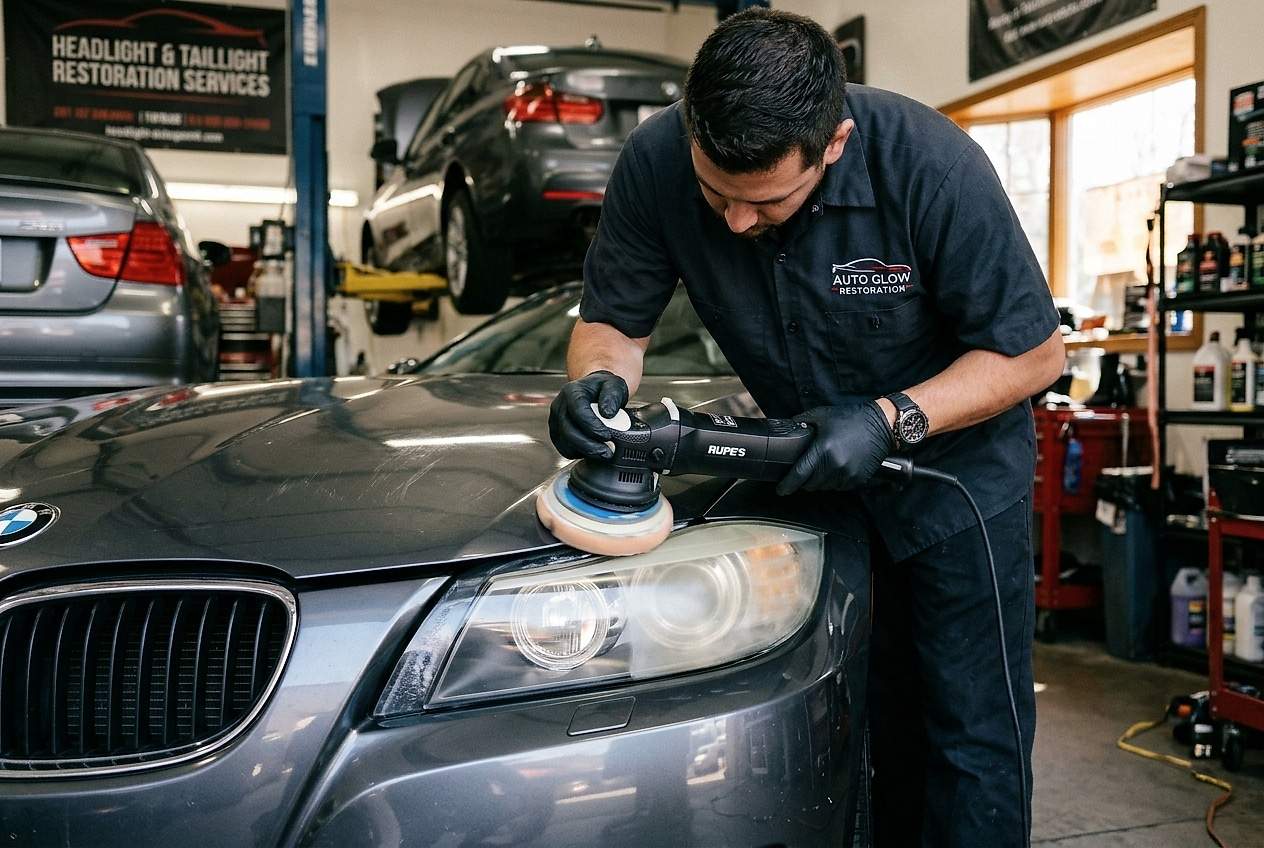
Professional restoration works in stages. Technicians first wash and mask the surrounding paint. They then sand the lens with progressively finer abrasive grits, typically wet sanding, to remove the oxidized layer. Next comes a polishing compound that restores optical clarity. Finally, the technician applies a UV-resistant clear coat. Kits sold to professionals, such as those from DetailKing, package the abrasives, compounds, and sealants used in this sequence. [1]
Coating and longevity
The protective coat determines how long the restoration lasts. Polishing alone removes haze but leaves bare polycarbonate exposed to UV light, so the lens can yellow again within months. A sealed lens with a fresh UV coat resists that cycle far longer. Longevity therefore depends less on the polish than on whether the final sealing step was done correctly.
Case in point: a Phoenix-area mobile service
Mobile detailers in the Phoenix metro area face intense UV exposure, which accelerates lens yellowing on vehicles parked outdoors. Desertgatoraz.com, a mobile auto detailing service serving Mesa, Chandler, Tempe, Apache Junction, and Gilbert, offers exterior detailing that can address headlight haze as part of a broader exterior service. Owners in these cities who park outside all day benefit most from sealing the lenses after restoration.
Synthesis: what this means for vehicle owners and detailers
Vehicle owners should treat headlight haze as a safety item, not a cosmetic one. Detailers should treat restoration as a multi-stage process and never skip the UV sealant. Fleet managers with many outdoor-parked vehicles should schedule restoration with recurring resealing. Pricing reflects this effort: Glasweld notes that "Most headlight repair pros charge around $100-200 per pair of headlights." [2]
What most people get wrong
Most people assume a quick polish fixes a yellowed headlight permanently. Polishing removes the visible haze but not the underlying UV damage to the polycarbonate. Without a UV-resistant clear coat, the lens begins to yellow again, often within months in sun-heavy climates. A lasting result requires the sealing step.
Common mistakes to avoid
- Polishing without sealing. The haze returns quickly. Always apply a UV-resistant clear coat after polishing.
- Using abrasive household cleaners. These scratch the lens. Use purpose-made restoration compounds.
- Skipping masking. Abrasives can damage paint. Mask the surrounding bodywork before sanding.
- Ignoring taillights. Taillights yellow the same way. Restore them alongside the headlights for a uniform appearance.
- Choosing the cheapest option without checking the coat. Ask whether a UV sealant is included before booking.
What this means for you
If your headlights look yellow or hazy, restore them promptly to recover beam output and improve night visibility. Ask any provider whether the service includes a UV sealant, since that step determines how long the result lasts.
If you run a detailing business, build restoration into your exterior packages with a clear sealing step and a stated expected lifespan. Compare your pricing against the market range before setting rates.
If you manage a fleet or park vehicles outdoors in the Phoenix area, schedule restoration with periodic resealing. The sun-heavy climate makes recurring protection the most cost-effective approach.
References
[1] DetailKing. "Professional Headlight Restoration Kits & Cleaning Supplies." DetailKing, 2026. https://www.detailking.com/collections/headlight-restoration
[2] Glasweld. "Professional Headlight Restoration Kits, Tools, & Training." Glasweld, 2026. https://glasweld.com/headlight-restoration/
[3] Performance Automotive Collision. "Headlight & Taillight Repair." Performance Automotive Collision, 2026. https://performanceautomotivecollision.com/headlight-taillight-repair/