
Kaydan Porter, Owner, Desert Gator Mobile Detailing
November 15th, 2026
7 min read
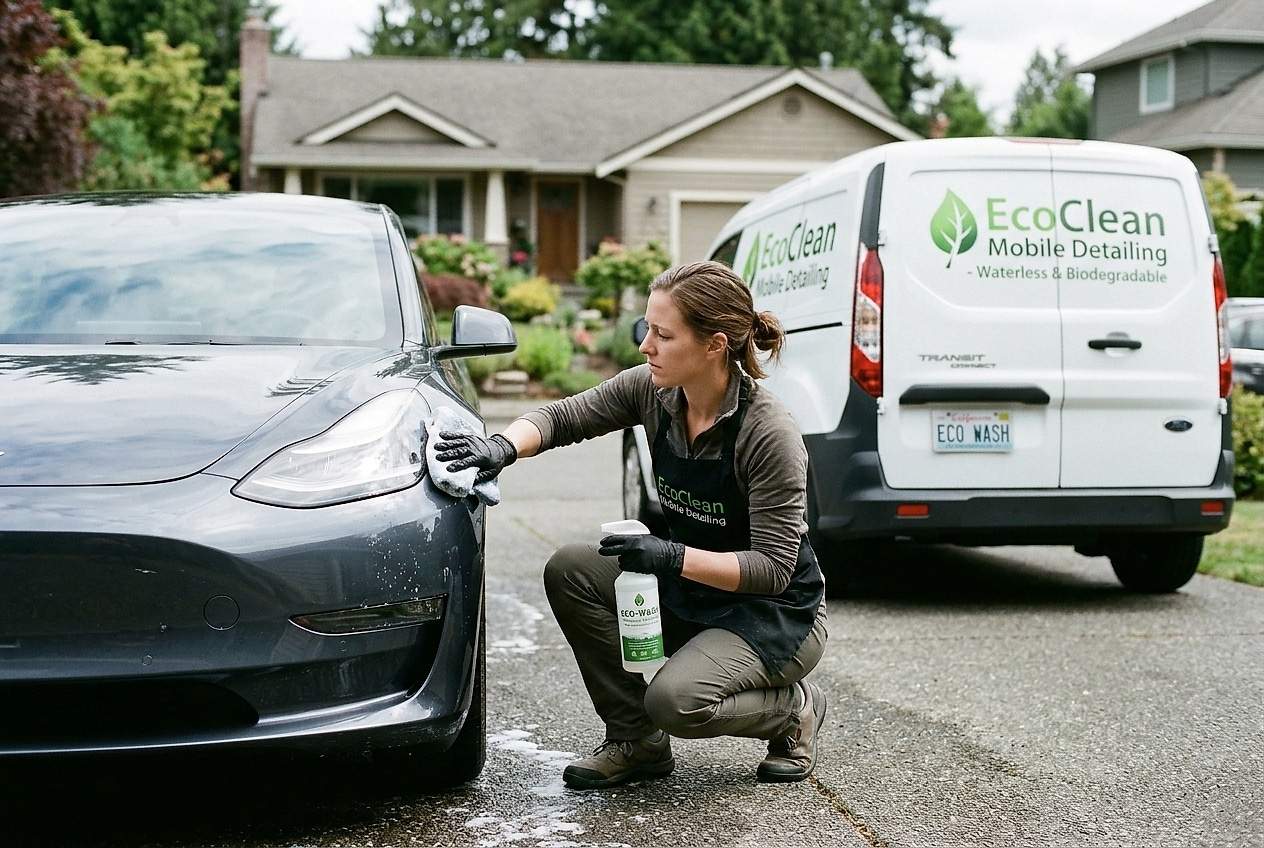
Eco-friendly mobile car detailing is genuinely effective at cleaning vehicles while using 97% less water and eliminating chemical runoff compared to traditional stationary car washes. The key is understanding which methods deliver results and which are marketing theater.
The framework for thinking about eco-friendly mobile detailing
Evaluating eco-friendly mobile car detailing requires three distinct dimensions: water consumption and runoff prevention, chemical composition and toxicity, and operational efficiency relative to environmental cost. These three axes determine both cleaning effectiveness and true environmental benefit. A service might score high on water savings but fail on chemical safety, or vice versa. Understanding each separately prevents greenwashing.
Water consumption and runoff prevention
Eco-friendly mobile detailing uses less than two gallons of water per vehicle, while traditional car washing methods may use 60 to 90 gallons of water.[3] This isn't marginal improvement; it's a structural difference in how the work gets done. Mobile services typically use waterless or near-waterless techniques: spray-on pH-balanced cleaners, microfiber towels, and sealed vacuums rather than water jets.
The runoff prevention matters as much as the volume. Traditional fixed-location car washes generate contaminated water—soap, wax residue, heavy metals from brake dust—that flows into storm drains and then into rivers and aquifers. Mobile detailing eliminates this pathway. "Mobile detailing eliminates the environmental impact of multiple vehicles traveling to and from a fixed location," according to Squeaky Pete's Detailing.[1] That's not just water savings; it's the prevention of point-source chemical pollution in the first place.
In Arizona, where groundwater tables in Mesa and Chandler sit within 300 feet of the surface, water conservation carries regulatory weight. Mobile detailing services operating in the Phoenix metro area sidestep the wastewater treatment overhead that fixed facilities bear.
Chemical composition and effectiveness
Eco-friendly detailing products use biodegradable surfactants instead of petroleum-derived soaps, and plant-based degreasers instead of solvents. The question isn't whether they exist; it's whether they clean as well. The answer is yes, with a caveat: effectiveness depends on application technique and dwell time, not just product chemistry.
Biodegradable surfactants break down in 28 days rather than persisting in soil and water. They cost 15-25% more per unit than conventional detergents but are applied in smaller volumes on mobile jobs, offsetting the per-unit premium. When a service reduces water by 85%, you're diluting less product anyway.
The trade-off: eco-friendly products often require longer contact time. A ceramic coating applied with conventional polymer sealant sets in 2 hours; plant-based alternatives may need 4-6 hours before full hardness. For mobile services targeting same-day turnaround, this means scheduling discipline. For customers in Gilbert or Apache Junction willing to wait, results match or exceed conventional detailing within a week.
Operational efficiency and carbon footprint
Mobile detailing scores a decisive win on transportation carbon cost. One technician with equipment drives to 4-6 customer locations per day instead of 40-60 customers traveling to one facility. That's 80-90% fewer vehicle miles per vehicle detailed.
However, this advantage erodes if the mobile service operates in a sprawling metro area with long gaps between appointments, or if inefficient routing means backtracking. Services using GPS routing and geofenced scheduling preserve the carbon advantage; those with ad-hoc booking lose it. "Mobile detailing eliminates the environmental impact of multiple vehicles traveling to and from a fixed location,"[1] but only if the service itself minimizes its own travel footprint through scheduling discipline.
Case in point: Regional mobile detailing in Metro Phoenix
A mobile detailing operation serving Mesa, Chandler, Tempe, and Apache Junction typically completes 4-5 detail jobs per day using approximately 8-10 gallons of water and eco-friendly cleaners. Operating in a concentrated metro cluster means route efficiency stays high. Over a year, that's roughly 1,800-2,000 vehicles detailed with minimal runoff and 90% less water than a fixed facility handling similar volume. The carbon cost of one technician driving 40 miles daily for scheduled routes (130 miles per week) is offset within the first month by eliminating customer travel to a central wash bay.
Synthesis: what this means for you
If you prioritize water conservation and prevention of chemical runoff, eco-friendly mobile detailing is the measurably superior choice. The savings are not theoretical: 2 gallons versus 60-90 gallons is a 97% reduction. For customers in water-stressed regions like Phoenix, this matters both environmentally and economically, as municipal water costs reflect scarcity.
If you care about cleaning results, the outcome depends on your timeline and the service's product quality. Eco-friendly detailing works as well as conventional methods, but application takes longer in most cases. Choose a provider with certifications or customer reviews specific to the finish you want (matte ceramic, high-gloss wax, protective sealant).
If you want the full environmental benefit, vet the service's routing and scheduling. A mobile detailer with 20-minute gaps between jobs defeats the transportation advantage. Services in concentrated service areas like desertgatoraz.com, which operates across Mesa, Chandler, Tempe, Gilbert, and Apache Junction, naturally optimize route efficiency better than those serving sprawling multi-county regions.
The 80/20 breakdown
80% of eco-friendly detailing's environmental benefit comes from water reduction (2 gallons versus 60-90) and runoff prevention. These are structural; they happen regardless of product brand or technique.
The remaining 20% depends on chemical biodegradability and operational routing. Skip evaluating biodegradable product certifications unless you're comparing two services with identical water and runoff practices. Prioritize asking about scheduling efficiency and service radius instead.
Skip waterless detailing claims unless the service explicitly covers wheels, undercarriage, and engine bay (most waterless methods don't). Focus instead on near-waterless techniques that use 2-3 gallons but achieve full coverage.
Eco-friendly mobile detailing vs. traditional fixed-location washing vs. waterless hand detailing
| Factor | Eco-Friendly Mobile | Traditional Fixed-Location | Waterless Hand Detailing |
|---|---|---|---|
| Water per vehicle | 2 gallons | 60–90 gallons | 0 gallons |
| Runoff contamination | None | High (point-source) | None |
| Customer travel miles | 0 | 5–15 per customer | 0 |
| Technician travel efficiency | High (4–6 stops/day) | Not applicable | Low (1–2 stops/day) |
| Drying time | 1–2 hours | 30 min | 2–4 hours |
| Wheel/undercarriage coverage | Full | Full | Limited |
| Cost per vehicle | $45–65 | $35–55 | $60–80 |
Eco-friendly mobile detailing wins on environmental metrics and operational efficiency. Waterless methods eliminate water entirely but cost 20–50% more and struggle with heavy contamination.
What this means for you
If you live in the Phoenix metro area, eco-friendly mobile detailing is available and practical. Services can reach you in Mesa, Chandler, Tempe, Gilbert, or Apache Junction with 48-hour scheduling. Book a service that discloses water usage and product ingredients rather than relying on "eco-friendly" marketing copy alone. Ask how many stops they schedule per day; that tells you whether they've optimized for carbon efficiency or just called themselves green.
If you have high-mileage vehicles or industrial contamination (brake dust, tar, salt residue), request a consultation before booking. Some eco-friendly products work faster on light contamination but need extra application time for heavy buildup. Set realistic timeline expectations rather than demanding same-day results with extended drying time.
If you're comparing cost between eco-friendly mobile, traditional fixed-location, and waterless options, ignore price alone. Calculate the real cost: service price plus your travel time to a fixed facility. Mobile detailing eliminates your travel while reducing water by 97% and preventing chemical runoff. That trade-off favors eco-friendly mobile for most customers willing to wait 48-72 hours for full curing.
References
[1] Squeaky Pete's Detailing. "Eco-Friendly Mobile Car Detailing Practices." https://www.squeakypetes.com/eco-friendly-mobile-car-detailing-practices
[3] Ecozone Mobile Detailing. "Eco-Friendly Detailing." https://ecozonemobiledetailing.com/